
Some background
The discussions around the proposed 20mph zones have really captured the public discourse over the last few weeks
It’s great that people are taking an interest and it really gives me hope for our island that this sort of democratic discussion can be fired up over something that will affect everyone in one way or another.
On the other hand though it’s clear there is a lot of misunderstanding out there & perhaps some politicians using this topic to pursue other political agendas…
So I figured I’d take the opportunity to just set out where this has all come from – I’m not commenting here on the merits or otherwise of the proposals or methodology just setting out some of the history to hopefully help inform the ongoing public discussions.
Where did it all start?
Back in July 2020 Mr Bill Shimmins MHK for Middle tabled a motion for Tynwald in respect of speed limits, Seconded by Mrs Kerry Sharpe MLC:
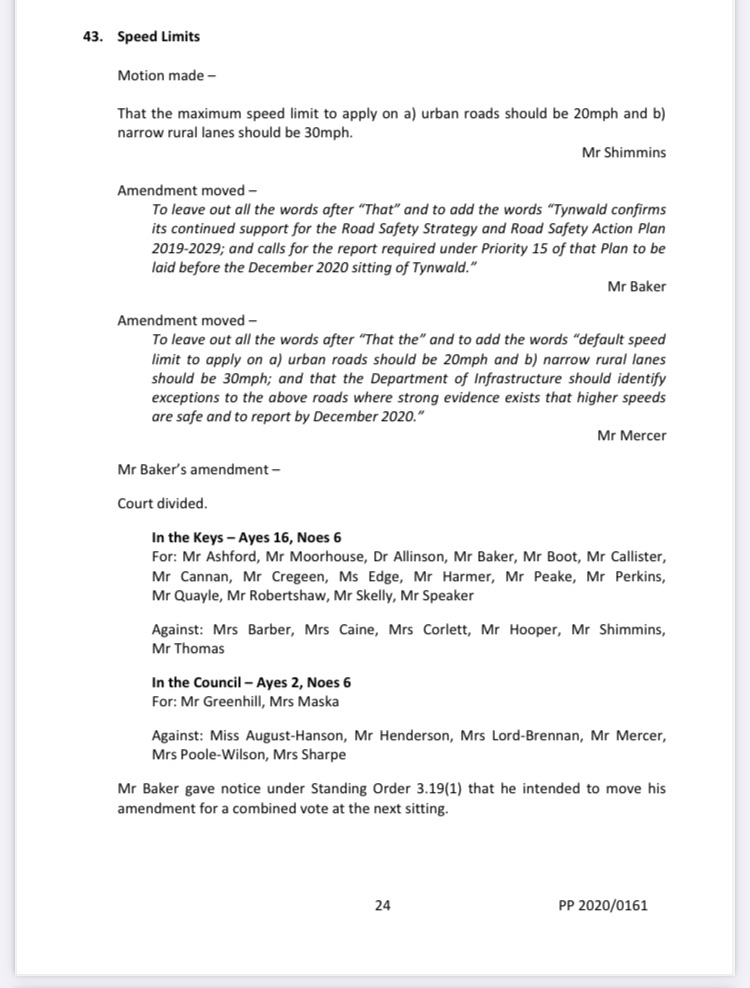
As you can see – pretty straightforward stuff. There was a decent debate held and a couple of amendments tabled that you can see in the image above.
This is where it gets a bit procedural.
The Infrastructure Minister at the time, Tim Baker MHK for Ayre and Michael had an amendment that was supported in the Keys but not in the Legislative Council. This means his amendment failed to be supported by both Branches and therefore fails.
When this happens though the mover (Mr Baker in this case) can call for a ‘combined vote’ to try and get an overall majority in Tynwald to overrule the objections of Legislative Council. This vote usually happens at the following sitting – giving at least a month for people to talk and see if a compromise can be reached.
On to October 2020…
The next sitting was October of the same year and so we duly moved to the combined vote.
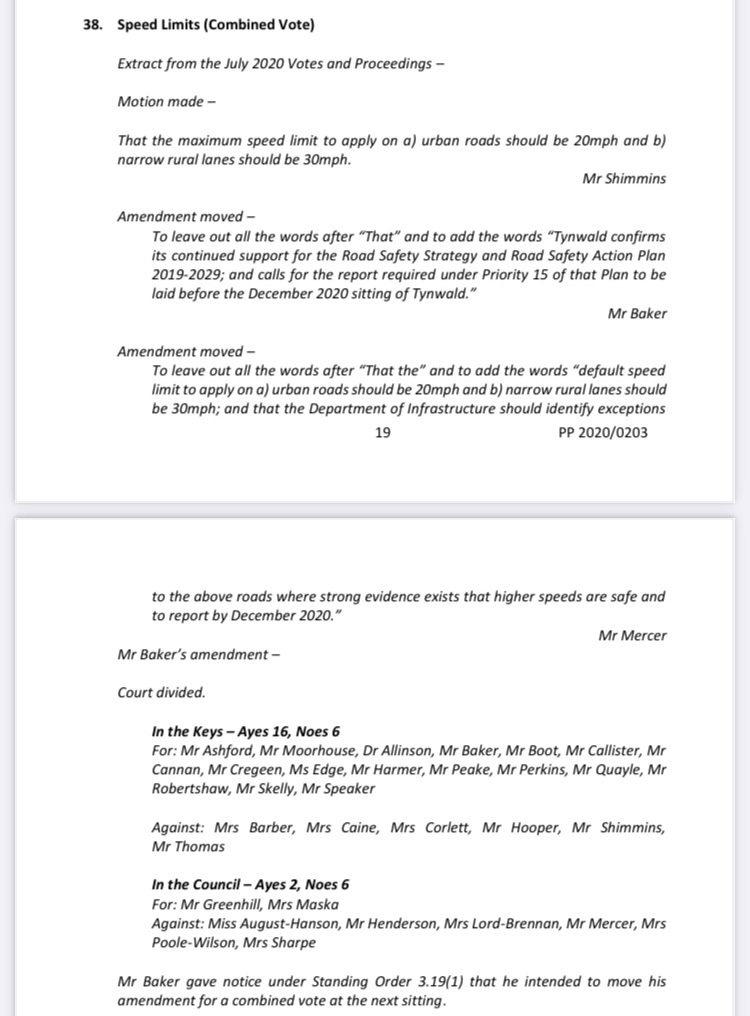
Here’s where it gets a bit more procedural…
When a combined vote happens there’s no further debate. A short recap is printed on the Order Paper but in the Tynwald Chamber it’s just straight to a vote.
Unless someone tables another amendment – then we have a full debate again (usually re-running a lot of the first debate because there’s nothing politicians like more than loudly repeating their own talking points)
Anyway, an amendment was duly tabled by Mrs Ann Corlett MHK for Douglas Central, seconded by Mrs Clare Barber MHK for Douglas East.

The amendment was debated and as you can see it was unanimously supported by Tynwald.
This is the decision that really matters
The decision made by Tynwald was that the default speed limit in residential areas should be 20mph but that the Department of Infrastructure could apply higher limits on individual roads where this is appropriate.
The aim was to have a report back by March 2021 on how this would be implemented – not whether it should be implemented.
So that’s it then?
Not quite. Because in typical government fashion they missed this deadline and the issue slipped quietly onto the back burner.
Not being one to give up, Mrs Corlett brought a motion back to Tynwald in February 2023 to remind government what Tynwald had decided and to give them a kick up the proverbial.
February 2023
This time the motion tabled was seconded by Mr Callister MHK for Onchan – but crucially it was the exact same as the previous motion. Nothing new, just reaffirming the decision Tynwald had already made.
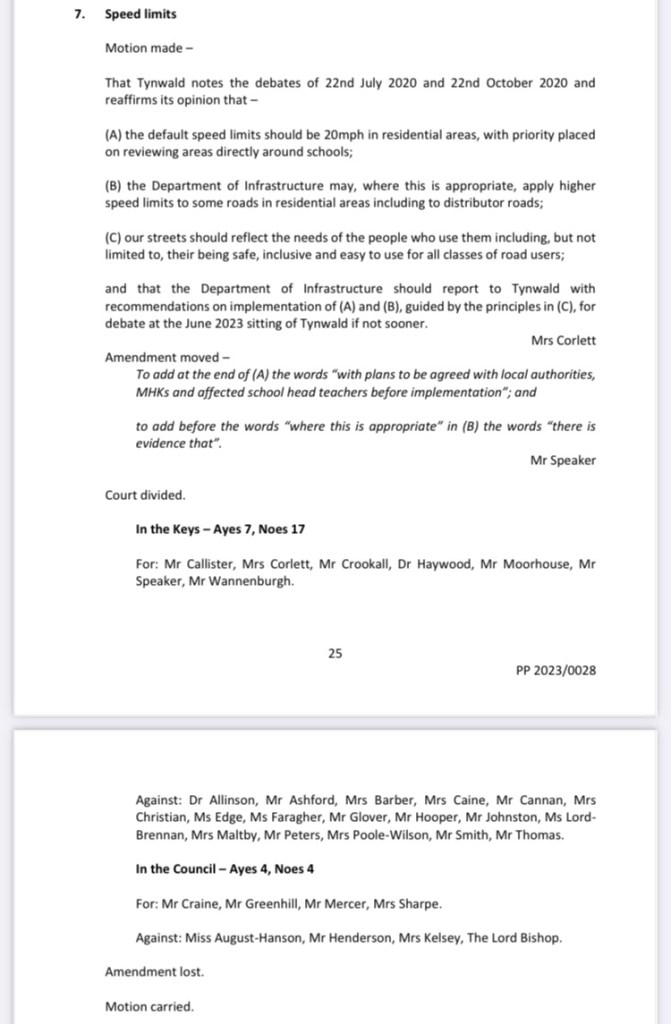
Again this was debated and during the debate something interesting happened.
An amendment came from the Speaker saying that local authorities, MHKs and schools should be required to agree to any plans before they were implemented.
Tynwald rejected this proposal.
Tynwald went on to again unanimously support the position that the default speed limit in residential areas should be 20mph but that the Department of Infrastructure could apply higher limits on individual roads where this is appropriate.
Again, Tynwald wanted a report back, by June 2023, on how (not whether) this should be implemented.
And again this didn’t happen on time but it was being worked on in the background.
So where does this leave us?
When Tynwald says to do a thing, government should do it or make a case to Tynwald why they can’t and get Tynwald to change its mind – but ultimately it’s Tynwald who should be in the driving seat.
When Tynwald says to do something – and then makes the same decision again reminding government that it should be doing that something – then government really should do it.
Government then duly proceeded with developing the plans required by Tynwald and the public debate reignited when the DOI finally sought public input on specific roads in early 2025.
In short?
Tynwald has decided that:
- The default speed limit in residential areas should be 20mph
- The Department of Infrastructure could apply higher limits on individual roads where this is appropriate.
- A plan on how to implement this should come to Tynwald (I read this as implying ‘for approval’ but this isn’t actually specified)
- That the agreement of local authorities, MHKs and schools is not required
The Department of Infrastructure (DOI) have been working on (2) & (3). They need to figure out which specific residential roads could have speed limits higher than 20mph where appropriate.
This is why they have gone out to the public for feedback on specific roads. As I said way back at the start I’m not commenting on the methodology or approach they’ve taken, but I think it’s fair to say that there has been a lot of public feedback.
The next step will be for the DOI to take this feedback on board and put their implementation plan to Tynwald – as the motions have all asked for.
The wording of the motion doesn’t leave much room for manoeuvre – Tynwald hasn’t asked for a report on the viability or desirability of 20mph zones, it has said to implement them by default and to figure out specific exceptions.
And finally….
It’s worth noting here that all of this has been driven by politicians, by Tynwald, not by the government.
The base of political support is also quite broad, different politicians from different constituencies and practically unanimous support in Tynwald itself.
This isn’t a pet project of one Minister—it’s a rare case of Tynwald flexing its collective muscle, with broad support across the political spectrum.

 Lawrie Hooper MHK
Thankyou Mr Hooper for this comprehensive history of the 20mph debate
A case of Tynwald deciding that they will go against the electorates opinions, the people that give them a living! The Chief Constable has said that he doesn’t have the man power to enforce these new limits. So if they aren’t going to be enforced what is the point? Democracy is listening to the people not just doing what you all want in Tynwald. The public opinion is against this!